Primordial soup: rings and chains from simulated particles
16,384 simulated particles, six kinds, one table of attractions. This filmed world contains rings, chains and moving clusters.
in development · simulated · illustrated
In Particle Life, a table sets how each kind of particle attracts or repels each other kind. The particles also repel at very short range and lose speed through drag. Starting from scattered particles, this run forms rings with coloured cores, segmented chains and moving clusters. These are simulated patterns; ‘species’ is our shorthand for recurring patterns, not biological species.
This page shows an initial world that has not been scored by the search. We plan to search many rule tables with open vision models, compare the scores with random rules, and test whether patterns recur from fresh starting seeds. Each published pattern will link to its rules and seed. That reloads the settings; GPU arithmetic can make the detailed motion differ between runs.
Explore the demo
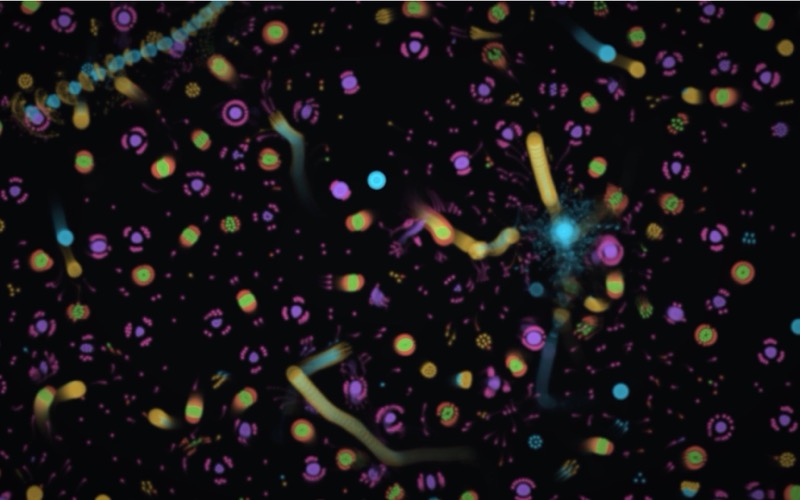
This world runs live in a browser with WebGPU; on this one, the film stands in for it.
The result
One simulated world of 16,384 particles forms rings, chains and moving clusters.
First world drawn and filmed; no search result yet.
- The world is 16,384 particles of six kinds under one random 6×6 attraction table, rule seed 7, world seed 17.
- The film shows ring-shaped clusters, segmented chains and moving clusters formed from seeded particle positions.
- No open-model score yet: this world has not been searched or judged.
Checks that passed
- Fixed-step film capture
- 900 of 900 frames · every frame
All listed result checks passed.
Methods
simulated · illustrated
Particle Life: 16,384 particles of 6 kinds, each pair of kinds attracting or repelling by one entry of a random 6×6 table (rule seed 7), with Tom Mohr's force law, run in WebGPU on the Sim Lab's neighbour-bin engine; filmed after a warm-up with a slow drift camera at 2× zoom
A simulation, not biological life. Glow, trails, colours and camera are illustrated.
Sources
- Tom Mohr, Particle Life (force law) · GPL-3.0; reimplemented independently, no code bundled
- Kumar et al. (2024), Automating the Search for Artificial Life with Foundation Models · CC BY 4.0
Credits
- Jeffrey Ventrella, Clusters · the asymmetric-attraction particle idea
- Tom Mohr, Particle Life · the force law and its default constants
- Kumar, Lu, Kirsch, Tang, Stanley, Isola and Ha (2024) · the particle-life parameterisation and the search design
- The Sim Lab Petri dish engine · the neighbour bins the kernels use