AI scientists, live: an open AI model looks for a neuron's firing threshold
In a recorded session, an open-weight AI model tested a simulated layer 5 pyramidal cell's firing threshold through Sim Lab tools. Its results are shown beside NEURON's.
in development · simulated · illustrated
We gave an open-weight AI model tools to run a simulated neuron and read its recordings. Its task was to find the rheobase of Hay's layer 5b pyramidal cell, the smallest 1000 ms current step that makes it fire. The model set a prediction rule before its trials, planned the current sweep and requested each run. A harness opened the scene, translated its requests into Lab OS calls, offered bisection and analysis helpers, and checked each conclusion before accepting it. The replay labels the model's and harness's calls and notebook text.
The replay shows the session as it was recorded: the notebook, every tool call, the cell's voltage during each run, the firing rate against current, and the range the model's runs leave for the threshold, beside NEURON's range for the same protocol. Runs that failed or contradict each other stay in. Any trial can be run again in your browser and compared with its record.
Where the model's server returned its reasoning, the replay shows it unedited beside each step. Waits in the session are condensed on playback, and the harness's re-checks play faster than the model's own steps. The clock shows the session's own time.
Explore the demo
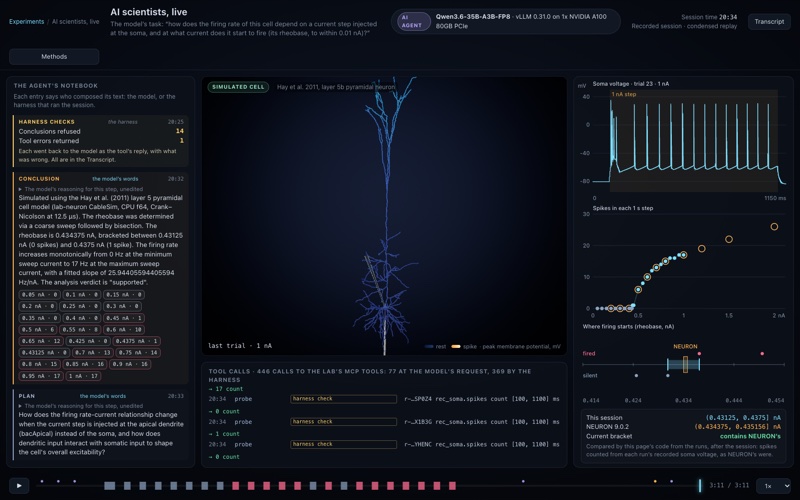
The replay draws the cell with WebGPU; on this browser, the film stands in for it.
The result
An open-weight AI model narrowed the firing threshold to 0.43125–0.4375 nA in 23 runs, a range containing NEURON's.
- In NEURON 9.0.2, Hay's cell starts firing for a 1000 ms step from rest between 0.434375 and 0.435156 nA.
- The model predicted a threshold between 0.05 and 1 nA. It swept 0.05–0.65 nA in 13 steps, bisected at 0.425, 0.4375 and 0.43125 nA, then swept on to 1 nA: 23 runs, leaving the threshold between 0.43125 nA (silent) and 0.4375 nA (one spike).
- The harness refused 14 of the model's conclusions before accepting one, each sent back to the model with what the check found wrong, and returned one failed tool request as an error. All of them are shown in the transcript.
- The model asked for 77 of the session's 446 calls to the Lab's tools. The harness made the other 369: 345 re-checking the model's conclusions, 23 in its final check and 1 to open the scene.
- The replay checks downloaded session files against the bundle's SHA-256 hashes and checks the session log's whole hash chain.
Checks that passed
- The model's final range contains NEURON's threshold
- 0.43125–0.4375 nA · contains 0.434375–0.435156 nA
- No silent run is at or above a firing run
- none: the 10 silent runs are all below the 13 that fired · no silent run at or above one that fired
- Browser replay: spike count, spike timing and voltage
- Spike count equal; times and voltage within bounds · Spike counts equal; times ±0.00154 ms; voltage ±0.00298 mV · Voltage is compared only more than 2 ms from a spike at that site. These bounds compare one trial's replay, not the sweep.
All listed result checks passed.
Methods
simulated · illustrated
Hay et al. 2011's layer 5b pyramidal cell (ModelDB 139653), stepped in float64 by Crank–Nicolson at 12.5 µs on the Lab OS server. NEURON 9.0.2 supplies the reference for the same protocol: 1000 ms soma current steps from 100 ms, starting at settled rest. Qwen3.6-35B-A3B-FP8 (Apache-2.0), served by us with vLLM 0.31.0 on one NVIDIA A100 80GB GPU, requested experiments through a harness. The published record includes a hash-chained session log, a notebook and a transcript.
The cell and the reference are simulations: this shows how an AI model runs experiments, not how a real neuron behaves.
Sources
- Hay et al. (2011), PLoS Comput Biol 7:e1002107; ModelDB 139653 · published model
- NEURON 9.0.2 · BSD-3-Clause
- Qwen3.6-35B-A3B-FP8 (Qwen Team), open weights · Apache-2.0
Credits
- Hay, Hill, Schürmann, Markram and Segev · layer 5 pyramidal cell model
- NEURON (Hines and Carnevale) · reference simulator
- Qwen Team, Alibaba Cloud · the open-weight AI model
- vLLM · model serving