Filament network: a particle rule table found by automated search
8,192 simulated particles, three kinds. An automated search kept this attraction table for the prompt "a jellyfish"; it draws an orange filament network with cyan nodes.
in development · simulated · illustrated
In Particle Life, a table sets how each kind of particle attracts or repels each other kind. An automated pilot search on our GPU mutates these tables and scores snapshots with two open vision models through open_clip; nothing is sent to a closed service. SigLIP SO400M-14-384 selects candidates by how well the images match a prompt, averaging its scores at model steps 1,000 and 1,500.
For “a jellyfish”, this table scored 0.068 against 0.055, the 99th percentile of 1,024 random tables. It also cleared that threshold on three new starting seeds. CLIP's score on the discovery run was below its own threshold.
"Species" is our shorthand for a recurring simulated pattern, not a biological species, and a score is a vision model's judgement of a picture, not a measure of life. The link reloads this exact rule table, particle count and seed; GPU arithmetic can make the detailed motion differ between runs.
Explore the demo
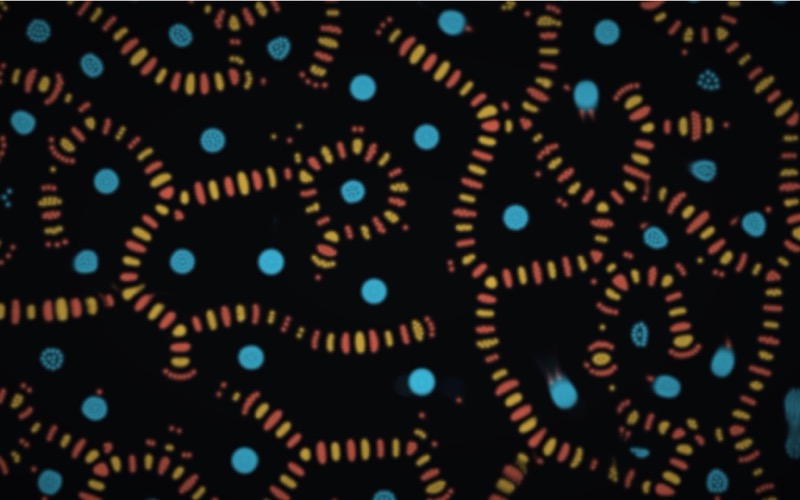
This world runs live in a browser with WebGPU; on this one, the film stands in for it.
The result
A rule table found by search clears its SigLIP threshold on the discovery seed and three new seeds.
Found by search; SigLIP threshold met on all four tested seeds, CLIP threshold missed on the discovery run.
- The world is 8,192 particles of three kinds under one attraction table, species p1-0004, world seed 150478.
- SigLIP SO400M-14-384 gave the prompt “a jellyfish” an average similarity score of 0.068 across two snapshots (model steps 1,000 and 1,500), above 0.055, the 99th percentile for 1,024 random tables.
- On the same two snapshots, CLIP ViT-B/32 averaged 0.219, below its own random baseline's 99th percentile of 0.223. SigLIP alone selected the table.
- The rule table cleared the SigLIP threshold on all four tested starting seeds: the discovery seed and three new seeds.
- Whether people find it more alive than random or hand-tuned tables has not been tested.
Checks that failed
- Second model (CLIP ViT-B/32) above its random baseline
- 0.219 against 0.223 · above its random tables' 99th percentile · not the selection criterion
Checks that passed
- SigLIP score above the random baseline
- 0.068 against 0.055 · above the random tables' 99th percentile
- SigLIP threshold across starting seeds
- 4 of 4 (discovery seed and 3 new seeds) · at least 3 of 4 above the baseline's 99th percentile
- Fixed-step film capture
- 900 of 900 frames · every frame
Methods
simulated · illustrated
Particle Life: 8,192 particles of 3 kinds under one attraction table found by an automated search scored with two open vision models through open_clip (SigLIP as the criterion, CLIP also scored), with Tom Mohr's force law, run in WebGPU on the Sim Lab's neighbour-bin engine.
A simulation, not biological life. Glow, trails, colours and camera are illustrated.
Sources
- Tom Mohr, Particle Life (force law) · GPL-3.0; reimplemented independently, no code bundled
- Kumar et al. (2024), Automating the Search for Artificial Life with Foundation Models · CC BY 4.0
- SigLIP SO400M-14-384 and CLIP ViT-B/32 via open_clip · Apache-2.0 and MIT weights
Credits
- Jeffrey Ventrella, Clusters · the asymmetric-attraction particle idea
- Tom Mohr, Particle Life · the force law and its default constants
- Kumar, Lu, Kirsch, Tang, Stanley, Isola and Ha (2024) · the particle-life parameterisation and the search design
- The Sim Lab Petri dish engine · the neighbour bins the kernels use