Rods and rings: a particle world found by automated search
8,192 simulated particles of five kinds form green-and-cyan rods and rings beside purple clusters. Their attraction table was found by automated search and scored by open vision models.
in development · simulated · illustrated
In Particle Life, a table sets how each kind of particle attracts or repels each other kind. An automated search selected this table using SigLIP SO400M-14-384 through open_clip, with the prompt “a microscope image of microorganisms”. CLIP ViT-B/32 was also scored.
“Species” is our shorthand for a simulated pattern. The search's distinctness rule compares pictures in a vision model's representation, not by human judgement. Using the same rule table and starting seed need not reproduce every detail of the motion, because GPU summation order can differ.
Explore the demo
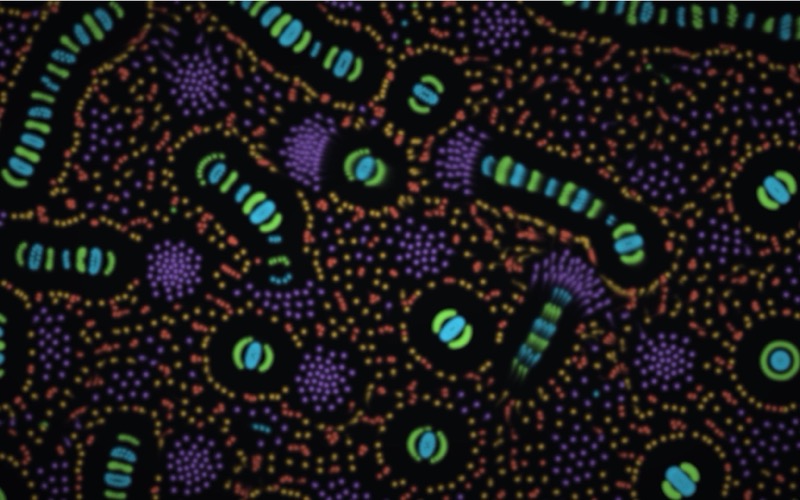
This world runs live in a browser with WebGPU; on this one, the film stands in for it.
The result
Banded rods, rings and purple clusters in a particle world found by automated search.
Found by automated search and filmed on one starting seed; the playable link is checked.
- The world is 8,192 particles of five kinds under one attraction table, species s1-0532, starting seed 490995.
- An automated search selected this table using SigLIP SO400M-14-384 through open_clip; CLIP ViT-B/32 was also scored.
- The playable link loads species s1-0532 with 8,192 particles and seed 490995 in the public Sim Lab.
The 60-second film uses starting seed 490995 and a slow drifting camera. It records 3,600 model steps after 240 warm-up steps. The camera moves across green-and-cyan rods, rings with cyan centres and purple clusters among orange and red dots.
Checks that passed
- Playable link loads this species, count and seed
- s1-0532, 8,192 particles, seed 490995 · an exact match
- Fixed-step film capture
- 1,800 of 1,800 frames · every frame
- Flash check on the film's exact bytes
- 2.5 luma, 0.0 linear and 0.0 red flashes/s; PASS. · under 3 a second
All listed result checks passed.
Methods
simulated · illustrated
Particle Life, 8,192 particles of five kinds; table s1-0532, seed 490995. WebGPU, 0.02-unit model steps, not physical time. Film: 1,800 frames at 30 fps; 3,600 steps after 240 warm-up steps. Selection: SigLIP SO400M-14-384 via open_clip, prompt “a microscope image of microorganisms”; CLIP ViT-B/32 also scored. Glow, trails, colours and camera illustrated. Sources: Ventrella; Mohr; Kumar et al. 2024 (ASAL).
Simulated patterns, not biological life. Vision-model scores do not show that people find them more lifelike. Glow, trails, colours and camera are illustrated.
Sources
- Tom Mohr, Particle Life (force law) · GPL-3.0; reimplemented independently, no code bundled
- Kumar et al. (2024), Automating the Search for Artificial Life with Foundation Models · CC BY 4.0
- SigLIP SO400M-14-384 and CLIP ViT-B/32 via open_clip · Apache-2.0 and MIT weights
Credits
- Jeffrey Ventrella, Clusters · the asymmetric-attraction particle idea
- Tom Mohr, Particle Life · the force law and its default constants
- Kumar, Lu, Kirsch, Tang, Stanley, Isola, Ha (2024), ASAL · the particle-life parameterisation and the search design
- Sim Lab Petri dish engine · the linked-list neighbour bins the kernels copy
- Sim Lab shell · the playable host, capture and labels
All experiments Segmented chains The filament network The first world